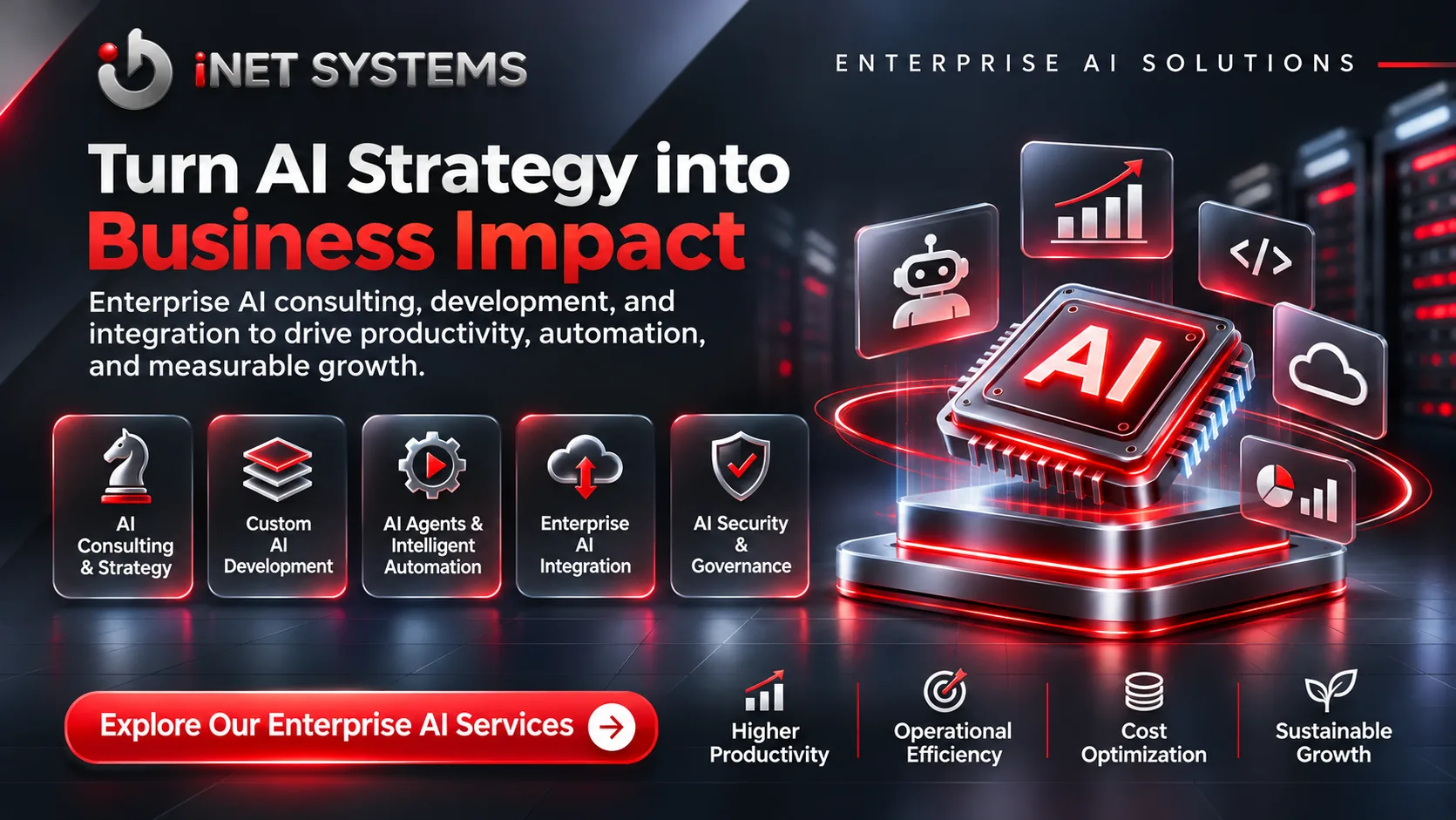
Enterprise AI solutions, AI consulting, custom AI development and intelligent automation.
Enterprise AI consulting services help organizations turn artificial intelligence into business value. AI is changing how organizations manage operations, serve customers, analyze information and make business decisions. However, implementing AI successfully requires more than selecting a model or purchasing an automation platform.
Businesses need an AI strategy that connects technology investments with operational priorities, secure enterprise data, existing applications and measurable outcomes.
Enterprise AI consulting services help organizations identify valuable AI use cases, design appropriate solutions, integrate AI into business workflows, and establish the governance needed for responsible adoption.
At iNET SYSTEMS INC., our enterprise technology approach focuses on connecting AI strategy, development, integration and operational requirements to business objectives.
Whether your organization is exploring custom AI development, AI agents, intelligent automation or enterprise AI integration, the goal should be the same: turn AI investments into practical business value.
What Are Enterprise AI Consulting Services?
Enterprise AI consulting services help businesses evaluate, plan, develop, implement and manage artificial intelligence solutions across their operations.
Unlike standalone AI tools, enterprise AI solutions must work within an organization’s existing technology environment, security requirements, business processes and governance structure.
A practical enterprise AI consulting engagement may include:
- AI readiness assessments and opportunity identification.
- AI strategy development and implementation roadmaps.
- Custom AI application design and development.
- Enterprise AI integration with existing applications and data.
- AI agent development and intelligent workflow automation.
- AI security, data protection and governance planning.
- AI deployment, monitoring and performance optimization.
The purpose is not simply to introduce AI. It is to solve business problems with technology that can be supported, secured and scaled.
Why Businesses Are Investing in Enterprise AI Solutions
Many organizations face similar operational challenges: disconnected applications, repetitive tasks, fragmented information, rising technology costs and slow decision-making processes.
Enterprise AI can help address these challenges when it is implemented against clearly defined business requirements.
1. Improve Operational Efficiency
Intelligent automation can reduce time spent on repetitive activities such as document processing, information classification, internal request routing and routine reporting.
This allows employees to spend more time on work requiring judgment, collaboration and customer interaction.
2. Connect Enterprise Data and Applications
AI becomes more useful when it can securely access relevant information from approved business systems.
Enterprise AI integration can connect AI-powered capabilities with customer relationship management systems, enterprise resource planning platforms, knowledge repositories and internal applications.
Appropriate access controls, data quality checks and integration architecture are essential.
3. Support Faster Business Decisions
AI-assisted analytics can help organizations examine large datasets, identify patterns, summarize information and support decision-making.
Human review remains important, particularly for decisions involving financial, operational, legal or security consequences.
4. Strengthen Scalability
Well-designed enterprise AI architecture can support growth across departments, workflows and business applications.
Scalability depends on factors such as infrastructure capacity, integration design, monitoring, data governance and cost management.
Enterprise AI Services for Business Transformation
AI Consulting and Strategy Development
Successful AI implementation begins with a clear understanding of business needs.
An AI strategy should identify operational bottlenecks, evaluate available data, assess technical readiness and establish measurable success criteria.
A practical strategy typically covers business priorities, implementation feasibility, security considerations, expected costs and deployment milestones.
Custom AI Development Services
Off-the-shelf AI products may not meet every organization’s requirements.
Custom AI development enables businesses to design AI-powered applications around specific processes, information sources, user experiences and operational constraints.
Potential applications include:
- Internal knowledge assistants.
- Document analysis and classification.
- AI-powered customer support workflows.
- Business reporting and analytics assistants.
- Intelligent search across approved enterprise content.
- Workflow-specific decision-support tools.
The appropriate solution depends on business requirements, data availability and integration complexity.
Enterprise AI Integration Services
One of the biggest challenges in AI adoption is connecting new capabilities with existing business technology.
Enterprise AI integration may involve APIs, enterprise applications, cloud services, databases, document repositories and identity management systems.
A reliable integration strategy should address authentication, authorization, data quality, logging, error handling and ongoing maintenance.
AI Agent Development and Intelligent Automation
AI agents can perform defined tasks using approved tools, business information and workflow instructions.
Depending on their design, AI agents may assist with information retrieval, request classification, workflow coordination and other operational processes.
However, agentic AI requires careful attention to permissions, action limits, monitoring and human approval for higher-risk activities.
Organizations should begin with narrow, measurable use cases before expanding intelligent automation across critical workflows.
AI Security and Governance
Enterprise AI adoption introduces important questions about data handling, model behavior, access control, accountability and regulatory obligations.
A responsible AI implementation approach should include:
- Clear data access and retention policies.
- Identity and permission controls.
- Protection of sensitive business information.
- Evaluation of model accuracy and reliability.
- Monitoring, audit logging and incident response procedures.
- Human oversight for consequential decisions.
Security and governance should be part of the initial architecture rather than added after deployment.
How to Implement Enterprise AI Successfully
A structured implementation process helps organizations control risk, prioritize investment and evaluate business outcomes.
- Assess AI readiness. Review existing applications, data quality, infrastructure, internal skills, security requirements and operational priorities.
- Identify high-value use cases. Prioritize opportunities using business impact, implementation complexity, data readiness, operational risk and expected costs.
- Define measurable success criteria. Establish baseline performance and relevant indicators such as processing time, error rates, employee hours saved, response quality or cost per transaction.
- Develop a controlled pilot. Build a limited implementation using representative data, defined user groups and appropriate security controls.
- Integrate and validate. Test integrations, access permissions, model outputs, exception handling and operational reliability before wider deployment.
- Scale and optimize. Expand successful implementations gradually while monitoring quality, adoption, infrastructure costs, security and business results.
A successful AI pilot is not the finish line. Reliable integration, ongoing monitoring and operational ownership are what make enterprise AI sustainable.
How to Evaluate the ROI of Enterprise AI
Businesses evaluating AI implementation services should assess the total economic impact of a proposed solution.
A useful framework is:
Estimated AI ROI (%) = [(Total Measurable Benefits − Total AI Costs) / Total AI Costs] × 100
Potential benefits may include reduced processing time, lower rework, improved service capacity and avoided operational costs.
Total costs should include development, licensing, cloud infrastructure, integration, security, testing, training and ongoing support.
For example, if an automation initiative costs $100,000 over a defined period and produces $150,000 in validated financial benefits, the estimated ROI would be 50%.
This is an illustrative calculation, not a forecast or performance claim for iNET SYSTEMS.
How to Choose an Enterprise AI Consulting Partner
Selecting an AI implementation partner requires evaluating more than technical demonstrations.
Consider whether a prospective partner can:
- Understand the business problem before recommending a technology.
- Design secure integrations with existing enterprise systems.
- Explain deployment architecture, governance and data protection.
- Define realistic milestones and measurable success criteria.
- Address ongoing support, monitoring and operational costs.
- Demonstrate relevant technical experience and implementation practices.
Ask prospective providers how they handle sensitive information, evaluate model performance, manage failures and maintain production systems.
A credible partner should be able to explain the tradeoffs of a proposed solution, not simply promise faster growth through AI.
Why Consider iNET SYSTEMS INC. for Enterprise AI Initiatives?
At iNET SYSTEMS INC., our focus is on connecting enterprise technology strategy with practical implementation requirements.
Organizations evaluating AI consulting and development services need solutions that account for business workflows, application integration, cloud infrastructure, security and long-term scalability.
Whether your project involves AI strategy, custom AI applications, intelligent automation or secure enterprise integration, the first step is understanding the business problem and identifying a realistic implementation path.
Our team welcomes conversations about enterprise AI requirements, technical challenges and potential implementation approaches.
Ready to Explore Enterprise AI for Your Business?
Turn AI strategy into practical business outcomes with iNET SYSTEMS INC.
If your organization is evaluating enterprise AI consulting services, custom AI development, AI implementation, AI agents or intelligent business automation, let’s discuss your business requirements.
Start with a conversation about your use case, existing systems and implementation priorities.
Contact iNET SYSTEMS INC.
- Website: https://inetsystems.ai/
- Contact: https://inetsystems.ai/contact/
- Email: adil.pasha@inetsystems.ai
