
Enterprise customers demand evidence
Bigger deals stall on SOC 2 or ISO 27001 evidence your team was never built to produce continuously.
Software companies need to move quickly and pass enterprise security reviews. We build platforms, pipelines and controls that make both possible.
Bigger deals stall on SOC 2 or ISO 27001 evidence your team was never built to produce continuously.
Infrastructure spend creeps up faster than the customer base that is supposed to justify it.
Each environment is configured slightly differently, and every release takes longer to ship safely.
Proving one customer can never see another customer’s data gets harder as the product grows.
| Framework | What it requires | How we address it |
|---|---|---|
| SOC 2 | Independently audited controls over security, availability and confidentiality. | Continuous control evidence, not a pre-audit scramble. |
| ISO 27001 | A certified information security management system. | ISMS alignment, policy and control mapping. |
| CCPA/CPRA | Lawful processing of personal data, consent, breach notification. | Data classification, encryption, access governance. |
| FedRAMP | Authorization requirements for cloud service providers selling to US federal agencies. | Control mapping, boundary design and continuous monitoring for public-sector sales. |
Focus areas: scalable platforms, SOC 2 readiness, DevOps acceleration, observability, and uptime.
Golden-path CI/CD and Kubernetes baselines so every environment ships the same safe way.
SOC 2 or ISO 27001 readiness with continuous evidence, not a scramble before the audit.
A governed foundation that keeps cloud cost proportional to growth, not runaway spend.
A governed data platform for product analytics and usage-based billing you can trust.
Governed AI features and internal agents shipped with evaluation and least-privilege access.
Ongoing monitoring and reliability work so engineers stay on product, not firefighting.
A reusable, secure deployment baseline every team ships on.
Continuous evidence collection instead of a pre-audit scramble.
Rightsizing and visibility that keeps unit economics healthy.
Multi-tenant data isolation that survives a security review.
Metrics, logs and traces wired in so incidents are diagnosed in minutes.
Governed guardrails for AI features shipped to customers.
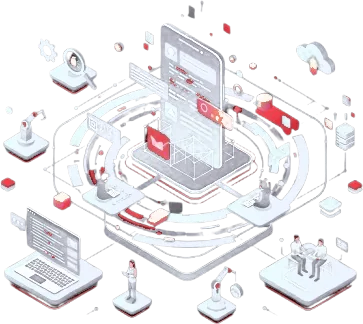
Customers reach multi-tenant applications through identity-verified access; an API and integration layer connects services and data pipelines; data lands in a governed, tenant-isolated platform; security monitoring and evidence collection span every layer.

Each phase leaves a working, adopted piece of the platform, not a standards document nobody reads.
Audit current deployment, security posture and the specific framework (SOC 2, ISO 27001) you need to pass.
Design the golden-path CI/CD, tenant isolation model and evidence collection approach.
Build the platform baseline and roll out continuous control evidence collection.
Test deployments, isolation boundaries and evidence exports before the real audit.
Hand over documentation, dashboards and on-call runbooks so engineers stay focused on product.
Every environment ships from the same golden path, so reliability and evidence stop depending on who built it.
Short answers to common planning questions for SaaS & Technology.
It depends on current posture, but most teams move from assessment to a defensible control set in 8-12 weeks, with evidence collection running continuously after.
No. It is built to be the fastest way to ship; teams move faster because they are not solving deployment and secrets from scratch each time.
Yes. Most engagements layer golden paths and evidence collection onto what you already run rather than starting over.
Yes. Scope adjusts to team size, from a first SOC 2 readiness pass to platform work for teams scaling fast.
A short platform and security baseline review, ending with a prioritized roadmap.
30-minute call · no obligation · reply within one business day.
Questions are not stored. Avoid sharing confidential information. Privacy Policy