
Manual Cluster Configurations
Engineers apply ad-hoc kubectl commands, causing configuration drift between staging and production clusters.
Kubernetes is unbeatable for resilient, containerized enterprise workloads when engineered correctly, but an operational liability when adopted without strict platform discipline. We build right-sized AKS, EKS, and GKE clusters hardened from the kernel up: Cilium eBPF network security, GitOps synchronization via ArgoCD, automated secret injection via HashiCorp Vault, and multi-tenant isolation. We give your platform team the guardrails to run container workloads reliably without midnight incident pages.
Client initiates an authenticated, TLS 1.3 encrypted connection from US or global networks.
Authoritative managed DNS resolves the domain endpoint with GeoDNS latency routing.
Edge security perimeter scrubs layer 7 attacks, OWASP Top 10 exploits, and DDoS anomalies.
High-throughput regional load balancer terminates TLS with perfect forward secrecy.
Envoy Ingress gateway directs traffic into Cilium eBPF mesh with kernel-level mTLS encryption.
Kubernetes internal virtual IP distributes requests across healthy, autoscaled workload pods.
Hardened rootless microservice pods process business logic and query US-region governed databases.
Eliminating fragile snowflake servers, slow manual releases, brittle scripts, and coordination overhead across engineering teams.
Engineers apply ad-hoc kubectl commands, causing configuration drift between staging and production clusters.
Any compromised pod can probe and communicate with all other pods across the entire cluster unrestricted.
Base64 Kubernetes secrets are committed to source control, creating critical credential exposure risks.
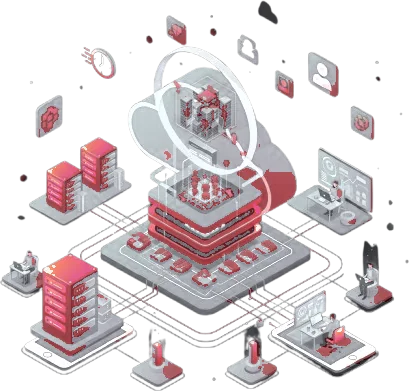
We build right-sized AKS, EKS, and GKE clusters hardened from the kernel up: Cilium eBPF network security, GitOps synchronization via ArgoCD, automated secret injection via HashiCorp Vault, and multi-tenant isolation. We give your platform team the guardrails to run container workloads reliably without midnight incident pages.
Provision managed clusters (AKS, EKS, GKE) using immutable, reviewed Terraform modules with automated node pool auto-scaling.
Enforce granular L3-L7 network policies, transparent mTLS encryption, and real-time network flow observability using Cilium.
Implement zero-touch declarative deployment workflows where Git is the single source of truth for all cluster workloads.
Eliminate hardcoded Kubernetes Secrets by injecting dynamic credentials directly from HashiCorp Vault or Azure Key Vault.
Enforce Pod Security Admission (PSA) restricted profile, disable root containers, and scan images for CVEs in CI/CD.
Deploy complete cluster metrics, persistent alerting rules, and distributed tracing across microservices with Grafana dashboards.
Architected around modular Infrastructure as Code, immutable container images, zero-trust network policies, and end-to-end telemetry.
Understand the business goal, current environment, risks and constraints before any design work begins.
Design the target operating model, controls and integration points so the solution fits how the business actually runs.
Build and configure the solution using repeatable, reviewed engineering practices, not one-off manual work.
Test against real scenarios and security requirements before anything reaches production.
Hand over documentation, runbooks and support so the client team can run the result with confidence.
Every phase ends with a documented deliverable and a clear go/no-go decision before the next one starts.
Standardizing Terraform modules, containerizing workloads with Kubernetes, automating release stages, and handing over runbooks.
Evaluate compute, memory, storage (CSI), and networking requirements to architect node pools and multi-tenancy models.
Deploy managed clusters via Terraform, configure Cilium / Calico CNI, and establish private API server endpoints.
Deploy ArgoCD, integrate cloud workload identities, and configure HashiCorp Vault / Azure Key Vault secrets injection.
Implement Kyverno / OPA policy gates, enforce restricted Pod Security Admission, and verify against the CIS Kubernetes Benchmark.
Perform migration dry-runs, validate Prometheus alerting, and transfer cluster operation runbooks to your engineering team.
Ship features safely multiple times a day with automated rollback, standardized developer environments, and comprehensive telemetry.
Cluster state is fully version-controlled; rollbacks and disaster recovery recreations take minutes.
Inter-service communication is encrypted and restricted strictly to explicitly authorized service paths.
Automated cordon and drain sequencing allows routine OS and Kubernetes version patching without outage.
Production-proven open standards and cloud-native tools selected for maintainability, security, and developer ergonomics.
One cloud base that every team reuses, so new setups are quick and stay in line.
Read the storyPractical guidance on container adoption, pipeline automation, and operational ownership.
For mission-critical production databases, we generally recommend managed cloud database services (like Azure Database for PostgreSQL or AWS RDS). When running stateful workloads inside the cluster is required, we deploy CSI drivers backed by resilient block storage with automated snapshots and Velero disaster recovery backups.
We configure Pod Disruption Budgets (PDBs) and utilize surge node pools. Upgrades sequentially cordon and gracefully drain nodes, rescheduling pods to newly patched nodes while ingress controllers continuously maintain health-checked traffic routing.
Yes. Our Kubernetes architectures implement NIST SP 800-53 controls: private cluster API endpoints with no public IP exposure, mutual TLS encryption between pods via eBPF, role-based access control tied to enterprise identity, and continuous image vulnerability scanning.
We deploy Velero integrated with encrypted cloud object storage to perform scheduled backups of cluster state, persistent volume data, and Custom Resource Definitions (CRDs). Because all configuration lives in Git via GitOps, rebuilding a complete cluster from scratch is fast and repeatable.
Questions are not stored. Avoid sharing confidential information. Privacy Policy