
CIDR Overlaps & Network Drift
Ad-hoc virtual network creation causes IP collisions that prevent peering with on-premises datacenters.
A cloud landing zone is the pre-built, governed architecture your enterprise workloads land on: multi-account hierarchy, non-overlapping IP address spaces, central transit routing, policy guardrails, and immutable audit logs, all deployed as Infrastructure as Code. Build it right, and every newly vended environment is secure, compliant, and operational by default. Skip it, and you spend years fighting network sprawl and security drift. We engineer repeatable, production-hardened landing zones across Azure, AWS, and Google Cloud.
Resolving inconsistent multi-account setups, unmanaged network egress, security drift, and unplanned cloud expenditure.
Ad-hoc virtual network creation causes IP collisions that prevent peering with on-premises datacenters.
Developers accidentally provision storage and virtual machines in unauthorized international regions.
Each subscription stores logs independently with no central retention, leaving severe compliance blind spots during audits.
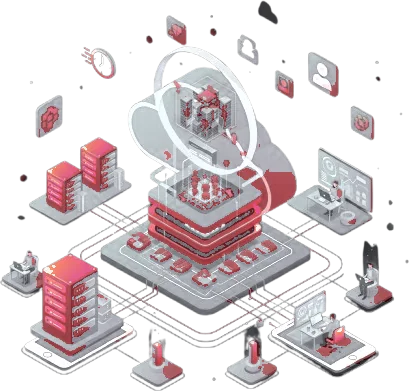
Build it right, and every newly vended environment is secure, compliant, and operational by default. Skip it, and you spend years fighting network sprawl and security drift. We engineer repeatable, production-hardened landing zones across Azure, AWS, and Google Cloud.
Design non-overlapping CIDR allocations, transit peering, centralized firewall inspection, and hybrid VPN/ExpressRoute gateways.
Structure multi-subscription governance with granular Role-Based Access Control (RBAC) and Privileged Identity Management (PIM).
Enforce mandatory encryption, restricted regional deployments (US regions), and tagging standards automatically via Azure Policy and AWS SCPs.
Aggregate management plane, network flow, and security telemetry into a tamper-proof, WORM-compliant central repository.
Deploy dedicated Key Vaults and HSM modules with private endpoints to secure certificates, keys, and connection strings.
Deliver reusable Terraform / Bicep modules enabling teams to vend fully compliant workload environments through self-service CI/CD.
Architected with automated guardrails, hub-spoke network topology, policy enforcement as code, and central logging.
Understand the business goal, current environment, risks and constraints before any design work begins.
Design the target operating model, controls and integration points so the solution fits how the business actually runs.
Build and configure the solution using repeatable, reviewed engineering practices, not one-off manual work.
Test against real scenarios and security requirements before anything reaches production.
Hand over documentation, runbooks and support so the client team can run the result with confidence.
Every phase ends with a documented deliverable and a clear go/no-go decision before the next one starts.
Systematic workload assessment, automated Terraform deployment, cutover execution with rollback protection, and FinOps tuning.
Map organizational hierarchy, assign dedicated non-overlapping IP blocks, and establish hybrid routing architecture.
Provision management group trees, configure Entra ID / IAM federation, and assign least-privilege administrative roles.
Deploy the central Hub network, firewalls, and logging vaults using modular, reviewed Terraform code.
Apply automated policies for encryption at rest/transit, backup policies, and regulatory controls (NIST CSF 2.0).
Integrate automated workload vending pipelines, conduct architecture reviews, and deliver living infrastructure runbooks.
Accelerate feature delivery across compliant infrastructure with US data residency built in.
Every new subscription automatically inherits networking, security policies, and monitoring configurations.
Automated policies block any deployment outside approved US datacenter regions.
New project teams receive a pre-configured, auditable subscription in minutes rather than weeks.
Built on leading enterprise cloud providers and automation platforms tested for mission-critical reliability.
One cloud base that every team reuses, so new setups are quick and stay in line.
Read the storyDirect answers regarding architecture choices, migration timelines, and operating ownership.
We establish a centralized IP Address Management (IPAM) strategy before writing code. We carve out distinct non-overlapping RFC 1918 supernets for Hub, Shared Services, Production, and Non-Production spokes, reserving address space for future on-premises or multi-cloud expansion.
Our landing zones enforce NIST controls as code: automatic disk and storage encryption, restriction of compute deployment exclusively to US governed regions, centralized immutable log retention, and separation of duties via isolated management subscriptions.
Yes. We frequently adopt brownfield environments by deploying the management group and policy hierarchy first, auditing existing resources in read-only mode, and then systematically migrating network interfaces and subscriptions into the governed topology.
Yes. Landing zones provide pre-approved guardrails. Developers can deploy their application services via GitOps pipelines without waiting for manual security tickets, because the landing zone policy layer prevents out-of-policy actions automatically.
Questions are not stored. Avoid sharing confidential information. Privacy Policy