
 Agentic AI
Unrestricted Tool Calling
Agents granted direct database connections execute hallucinated destructive SQL queries or broad table scans.
Autonomous AI agents capable of executing actions across enterprise databases, internal APIs, and operational systems represent a breakthrough in productivity, but an unacceptable risk if left ungoverned. We design and build enterprise agentic architectures anchored on the Model Context Protocol (MCP), strict least-privilege tool access, sandboxed execution runtimes, human-in-the-loop approval gates for irreversible actions, and immutable cryptographic audit logging. Trust is expanded as agents prove reliability, not granted blindly on day one.
Every tool call is routed through an MCP gateway, validated against fine-grained policies, and gated behind human approval where risk is high.
Agents given broad API keys can hallucinate parameters, perform destructive writes, or trigger unintended financial and operational consequences.
Moving AI from fragile prototypes to governed production requires solving data boundary security, token economics, and model auditability upfront.
Agents granted direct database connections execute hallucinated destructive SQL queries or broad table scans.
Multi-agent debates without execution limits burn hundreds of dollars in API tokens in minutes.
Customer personal identifiers are passed unmasked to foreign third-party model inference endpoints.
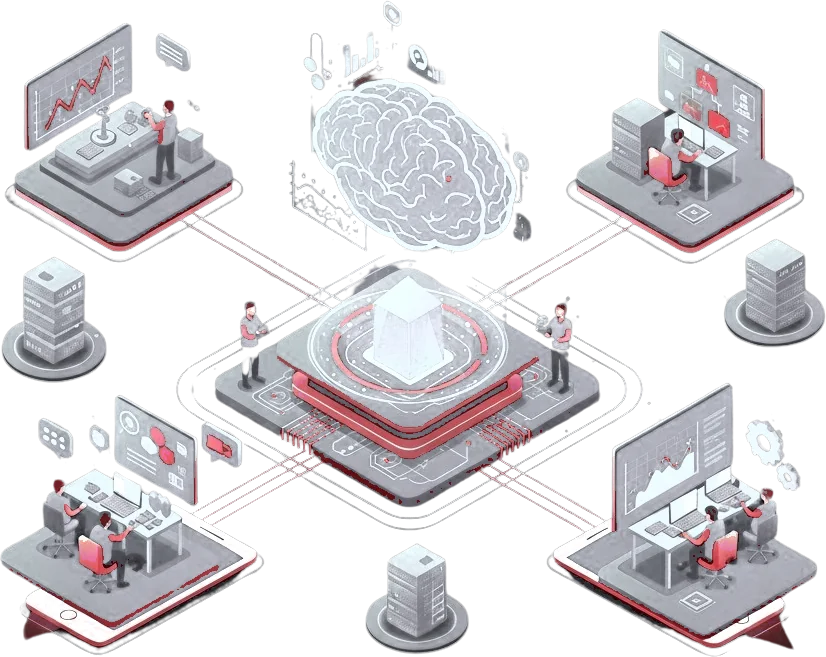
We design and build enterprise agentic architectures anchored on the Model Context Protocol (MCP), strict least-privilege tool access, sandboxed execution runtimes, human-in-the-loop approval gates for irreversible actions, and immutable cryptographic audit logging. Trust is expanded as agents prove reliability, not granted blindly on day one.
Standardize agent-to-tool communication with secure MCP servers that decouple reasoning models from raw database and API credentials.
Issue ephemeral, least-privilege tokens for every tool call so agents never hold perpetual administrative credentials.
Require multi-factor human authorization for sensitive operations, such as financial transfers, record deletions, or customer communications.
Run code interpretation and data transformation tools in isolated microVMs or ephemeral containers with no outbound internet egress.
Enforce hard loop boundaries, token consumption caps, and execution timeouts to prevent runaway recursive agent loops.
Record every prompt, decision trajectory, tool argument, and system response in tamper-evident logs for compliance.
We establish isolated network boundaries, least-privilege tool access via MCP, identity enforcement, and comprehensive audit telemetry before launch.
Understand the business goal, current environment, risks and constraints before any design work begins.
Design the target operating model, controls and integration points so the solution fits how the business actually runs.
Build and configure the solution using repeatable, reviewed engineering practices, not one-off manual work.
Test against real scenarios and security requirements before anything reaches production.
Hand over documentation, runbooks and support so the client team can run the result with confidence.
Every phase ends with a documented deliverable and a clear go/no-go decision before the next one starts.
Every milestone validates accuracy, latency, safety guardrails and regional data residency before widening organizational access.
Break down the target workflow into discrete sub-tasks and classify each by business impact and data sensitivity.
Build custom MCP servers with scoped OpenAPI connectors and deploy isolated runtime execution sandboxes.
Implement parameter validation, prompt injection shields, and human escalation triggers for critical paths.
Simulate malicious inputs, prompt injection attacks, and edge cases to verify containment and error handling.
Deploy to a restricted pilot group with real-time token tracking, anomaly alerts, and comprehensive operations runbooks.
Equip enterprise workflows with verified intelligence without exposing sensitive enterprise data or falling out of regulatory compliance.
Strict policy engine rejects any tool invocation outside the explicit operational boundary.
Automated circuit breakers kill divergent loops before token quotas are exceeded.
Complete visibility into why an agent chose a specific tool and how each conclusion was reached.
Industry-standard AI platforms engineered for predictable inference latency, high security, and regional data residency.
AI agents got only the tools they need, through one gateway, with every call logged.
Read the storyDirect answers regarding model evaluation, security boundaries, and production readiness.
We implement an architectural barrier using the Model Context Protocol (MCP). The LLM never touches credentials or systems directly. Instead, it proposes a tool invocation to our MCP Gateway, which validates the payload against an enterprise policy engine. If an action is marked irreversible (e.g., executing a database write or money transfer), it is held until an authorized human approves it.
Yes. We host models within regional Azure/cloud instances located in the United States or approved regional datacenters. Sensitive fields (like National IDs and phone numbers) are masked or tokenized on-premises before reaching the model context, and all tool execution happens inside private network enclaves.
Our MCP gateways enforce strict JSON schema validation and type checking on every argument. If the agent outputs malformed parameters or an unapproved function name, the gateway rejects the call, returns a structured error to the agent, and prompts it to retry with valid constraints.
We build hard execution guardrails into the agent orchestrator: maximum step limits per conversation turn (e.g., 5 tool iterations), hard per-task token ceilings, timeout cutoffs, and cost-aware circuit breakers that alert human engineers if anomaly thresholds are crossed.
Questions are not stored. Avoid sharing confidential information. Privacy Policy