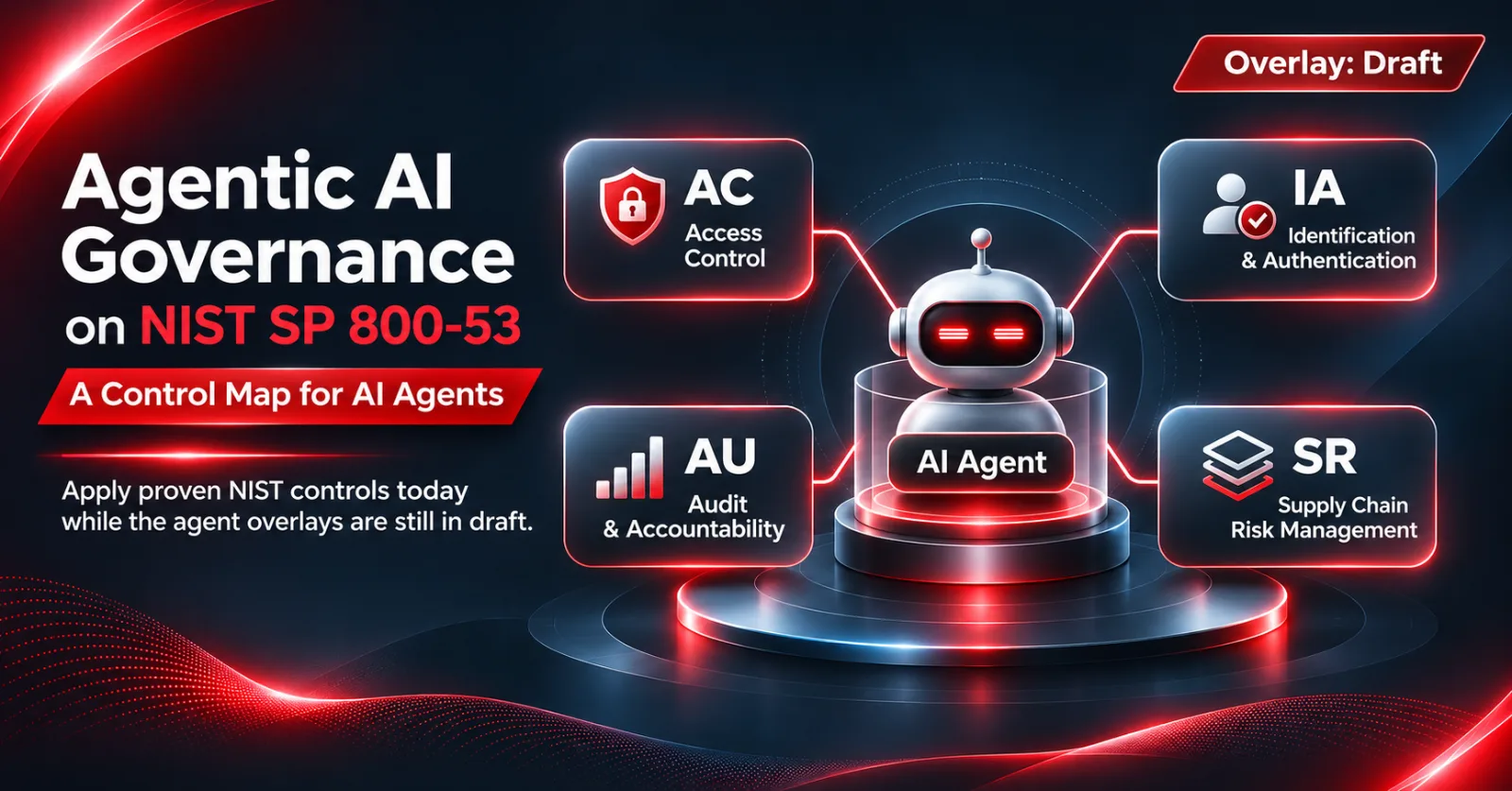
Key takeaway: You don’t need to wait for National Institute of Standards and Technology (NIST)’s agent-specific overlays to govern artificial intelligence (AI) agents. Governance for AI agents can run on the NIST Special Publication (SP) 800-53 controls you already audit. Give each agent its own identity (IA), scope its permissions to the task (AC), log actions to a non-human principal (AU) and vet every tool and Model Context Protocol (MCP) server (SR).
Agentic AI governance is the set of policies, ownership rules and technical controls that decide what autonomous AI agents may do, with whose authority, and how their actions are recorded, reviewed and stopped. Most enterprises already run that machinery for people and servers through NIST SP 800-53. The question is how to stretch it to cover agents. Our agentic AI governance framework for chief information security officers (CISOs) covers the program around it.
That question got sharper this week. On November 12, 2026, Amazon Web Services (AWS)’s disclosure of a server-side request forgery flaw in its open-source MCP gateway registry was reported (Cybersecurity News). This week, too, Arctic Wolf described AWS intrusions where one successful secret read hid among hundreds of denied calls (The Hacker News). Both are governance failures as much as security bugs. Below is the control map we use with clients who run SP 800-53, Federal Risk and Authorization Management Program (FedRAMP) or System and Organization Controls 2 (SOC 2) programs.
Where does NIST stand on AI agent controls in late 2026?
NIST has started several agent workstreams, but none has produced final control guidance yet. The process standard (AI Risk Management Framework (RMF)) is final. The control catalog for agents (the COSAiS overlays) is still in draft.
Here is the timeline that matters:
- August 2025: NIST announced COSAiS (Control Overlays for Securing AI Systems), a project to adapt SP 800-53 to five AI use cases. Two of them are agentic: single-agent and multi-agent systems.
- January 8, 2026: Center for AI Standards and Innovation (CAISI) published a Request for Information on securing AI agents (docket NIST-2025-0035). Comments closed on March 9, and the docket drew 937 comments (Containment.ai).
- February 5, 2026: NIST’s National Cybersecurity Center of Excellence (NCCoE) released a concept paper, Accelerating the Adoption of Software and AI Agent Identity and Authorization. It asked about identifying, authorizing, auditing and ensuring non-repudiation for agents, and comments closed on April 2.
- February 17, 2026: CAISI formally launched the AI Agent Standards Initiative.
- As of August 2026: NIST’s own COSAiS page (last updated January 8, 2026) shows only one overlay in draft, an annotated outline for predictive AI. The agent overlays have no announced publication date.
In practice, this means the controls you’ll be measured against later are being written now. Teams that map agents onto existing SP 800-53 controls today will be adjusting a mapping, not starting from zero.
Which SP 800-53 control families fail for AI agents?
According to a Cloud Security Alliance analysis of NIST’s agent work, four families have the biggest gaps: Access Control (AC), Identification and Authentication (IA), Audit and Accountability (AU) and Supply Chain Risk Management (SR). Each one assumes a human or a fixed system is the actor.
Here are the gaps in plain terms:
- AC: An agent’s permissions can be unbounded. The catalog has no control that scopes permissions to the task the agent is doing right now.
- IA: Existing controls don’t tell an AI agent apart from the human operator it acts for.
- AU: Agent actions are often logged under a human’s identity. That breaks forensic attribution.
- SR: Every tool integration, MCP server and model provider is a supply-chain dependency, and these change constantly.
This week’s news shows two of these gaps clearly. The AWS mcp-gateway-registry flaw (CVE-2026-125926, fixed in v1.35.0) let an authenticated user point the gateway at internal services. That is an SR and AC problem: a tool layer with more network reach than anyone intended. The AntiFox-linked intrusions show the AU problem. A single successful GetSecretValue call is easy to miss among hundreds of denials unless someone correlates them.
How do you map AI agents to SP 800-53 controls today?
Take the controls you already implement and apply them to the agent as a principal in its own right. Don’t treat it as a feature of the app that hosts it. The table below is our working map. It isn’t NIST’s overlay, so revisit it when COSAiS publishes. The controls come from the public SP 800-53 Rev. 5 catalog.
| Family | Representative controls | What it means for an agent | Evidence to keep |
|---|---|---|---|
| AC | AC-2 account management, AC-6 least privilege | One account per agent with a named owner. Scopes are tied to the task, and write or delete rights are separate from read rights. | Agent register with owner, scopes and review date |
| IA | IA-2 / IA-9 identification of users and services | The agent authenticates as a workload, never with a person’s token. Use short-lived federated credentials. | Identity provider config and token lifetime settings |
| AU | AU-2 event logging, AU-10 non-repudiation | Every tool call is logged with agent ID, delegating user, input source and outcome. | Security information and event management (SIEM) queries and a sample action trail |
| SR | SR-3 supply chain controls, SR-11 component authenticity | Tools, MCP servers and models come from approved sources, with pinned versions and signatures where offered. | AI bill of materials (AIBOM), version pins and patch records |
| CM (Configuration Management) | CM-7 least functionality | Turn off tools and egress paths the agent doesn’t need. | Tool allow-list and egress policy |
| IR (Incident Response) | IR-4 incident handling | You can revoke the agent’s credentials and stop it within minutes. | Kill-switch runbook and exercise log |
The rule we enforce in every mapping is that the agent is the principal and the human is the delegator. Both appear in the log. If you can’t tell which one acted, AU-10 fails.
“Most agent governance problems we see aren’t exotic AI problems. They’re old SP 800-53 problems wearing a new badge: a shared service account, a log line that names the wrong person, a plugin nobody vetted. Fix those three and you’ve done most of the work the overlays will ask for.”
iNET SYSTEMS AI Practice
What does an 8-step NIST SP 800-53 rollout for AI agents look like?
Start with inventory and ownership, then fix identity, then logging. Leave red-teaming and policy-as-code for last. Most mid-size programs finish the first pass in one quarter.
- Inventory every agent. Include software as a service (SaaS) copilots, coding agents, workflow agents and home-built ones. Record the owner, model, tools, MCP servers, credentials and data stores.
- Assign accountable owners. Each agent needs a business owner who accepts the risk and a technical owner who runs it.
- Tier agents by blast radius. Read-only, draft-for-review, write-in-production and irreversible actions each get a different approval path.
- Issue non-human identities. Use short-lived, federated workload credentials and remove human tokens from agents (IA, AC). See Entra ID and identity security.
- Log agent and delegator. Send every tool call to your SIEM, such as Microsoft Sentinel, with both identities, and alert on denied-then-allowed patterns (AU).
- Vet the tool supply chain. Approve MCP servers and connectors the way you approve libraries. Pin versions and patch on disclosure, as with this week’s mcp-gateway fix (SR). Our continuous integration and continuous delivery (CI/CD) pipeline security guide covers the same controls for build tools.
- Gate irreversible actions. Require human approval for deletes, payments, identity and access management (IAM) changes and external sends. Our guide to runtime controls for AI agents covers the approval gates and kill switch.
- Test and review. Run an AI agent security assessment before production and after major changes, and re-certify access every quarter.
How does this fit with NIST AI RMF, ISO 42001 and OWASP?
SP 800-53 gives you the controls. The NIST AI RMF gives you the process, ISO/IEC 42001 gives you the management system, and OWASP gives you the threats. Each framework covers a different layer of the same program. For the clause-by-clause view, see our EU AI Act and ISO 42001 crosswalk.
| Framework | Role in agentic AI governance | How it uses this control map |
|---|---|---|
| NIST SP 800-53 (+ COSAiS overlays when final) | Control catalog | This map is the implementation |
| National Institute of Standards and Technology (NIST) AI Risk Management Framework (AI RMF) 1.0 | Govern, Map, Measure, Manage process | Controls feed “Manage”; inventory feeds “Map” |
| International Organization for Standardization and International Electrotechnical Commission (ISO/IEC) 42001 | Certifiable AI management system | The map is evidence for its operational controls |
| Open Worldwide Application Security Project (OWASP) Top 10 for Agentic Applications 2026 | Threat taxonomy (ASI01–ASI10) | Use it to test whether the controls actually hold |
| European Union (EU) AI Act | Legal obligations by risk class | High-risk Annex III duties now apply from December 2, 2027 |
OWASP’s GenAI Security Project has also published a GenAI Security Industry Framework Crosswalk and an Agent Control Standard (ACS) alongside its agentic Top 10. Check both if you need to align several frameworks at once.
What evidence will auditors ask for?
Auditors will want proof that each agent is a known, owned, least-privileged and logged principal. They’ll also want proof that you can stop it. Policies alone won’t be enough.
Prepare these artifacts:
- An agent register (AIBOM) with owners, tiers, tools and review dates
- Identity configuration that shows per-agent workload credentials and token lifetimes
- A sample end-to-end action trail that shows agent, delegator, tool, input source and result
- Approved-tool and MCP server list with version pins and patch history
- Approval-gate configuration for irreversible actions
- The latest kill-switch exercise and red-team report
If your program runs on SOC 2 or FedRAMP, our compliance readiness team can bring agents into your existing audit scope.
Bring your agents into scope before your auditor does
Book a NIST SP 800-53 assessment for your AI agents with iNET SYSTEMS. We’ll inventory your agents, map them to your SP 800-53, SOC 2 or ISO 42001 controls, and hand you a prioritized plan with the audit evidence already outlined. Book your assessment.
