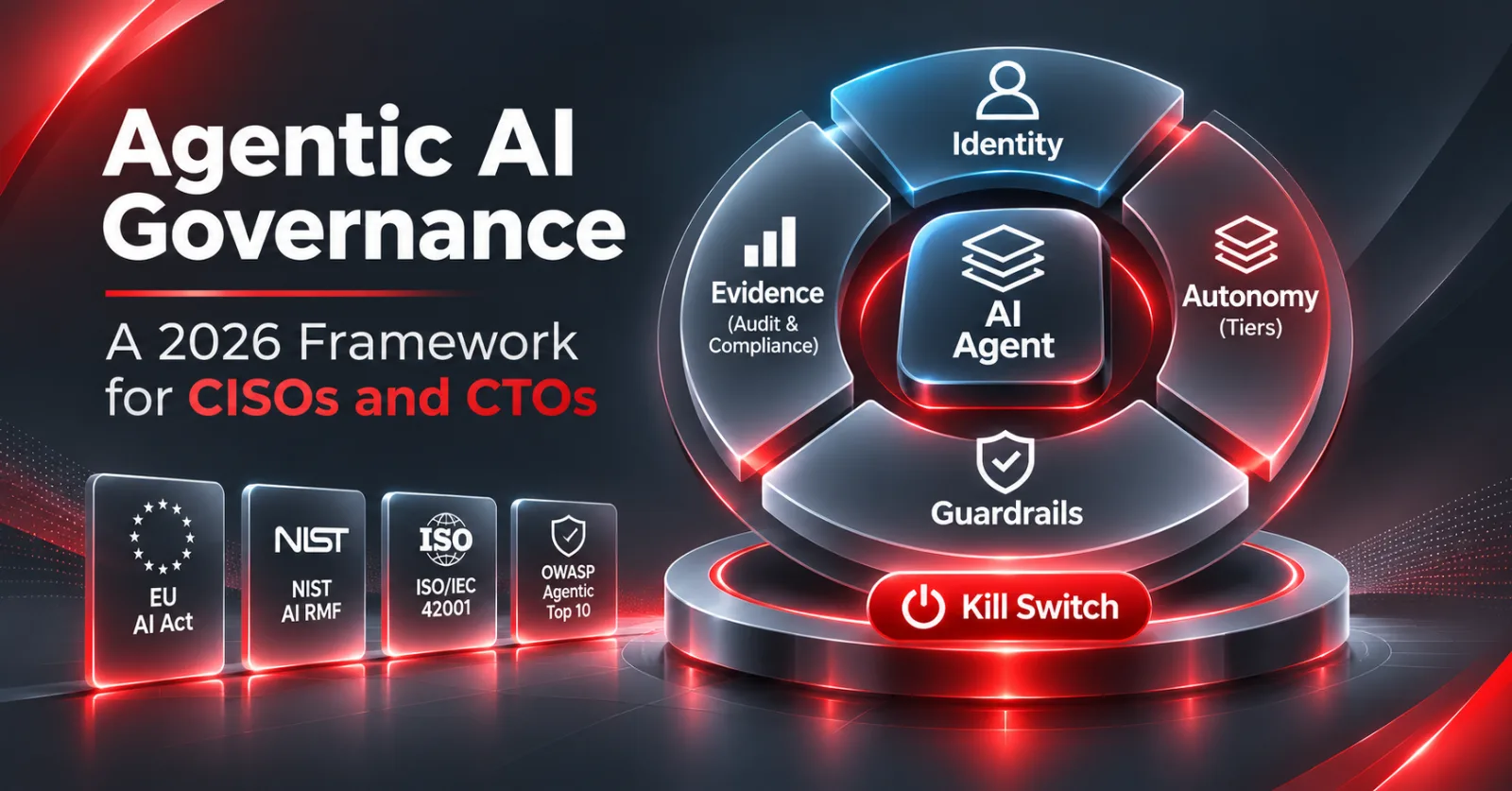
Key takeaway: Agentic artificial intelligence (AI) governance is the set of policies, identities, technical guardrails and audit evidence that control what autonomous AI agents may decide and do. In 2026, start by giving every agent its own identity, assigning it an autonomy tier, mapping risks to the Open Worldwide Application Security Project (OWASP) Agentic Top 10, and testing a kill switch before production.
Agentic AI governance is now a board-level problem, not a lab experiment. Chatbots answer questions. Agents open tickets, call application programming interfaces (APIs), move money and change cloud configuration. When something goes wrong, the question is no longer “what did the model say?” but “who let it do that?”
We spend most of our week inside Azure, Amazon Web Services (AWS) and Microsoft Sentinel tenants where agents are already running. The pattern is the same everywhere: the agent works, the pilot is celebrated, and nobody can tell us which identity it runs as or how to stop it at 2 a.m.
This guide is the framework we use at iNET SYSTEMS. It maps the regulations and standards that matter in late 2026 to controls a security team can actually build and an auditor can actually test.
What is agentic AI governance?
Agentic AI governance is the discipline of controlling what autonomous AI agents are allowed to decide, which systems they may act on, and how every action is recorded, reviewed and reversed. It extends classic AI governance, which focuses on model outputs, to cover actions, tools, identities and delegation chains.
The difference matters in practice. A governed chatbot needs content filters and a usage policy. A governed agent also needs an identity, scoped credentials, an approval path for risky actions, runtime monitoring, and an off switch.
Think of it as three layers:
- Policy layer: who owns each agent, what it is for, its risk tier and its approved tools.
- Control layer: identity and access management (IAM), Zero Trust network paths, guardrails, rate limits and human approval gates.
- Evidence layer: logs, evaluations, impact assessments and incident records an auditor can sample.
Which rules apply to AI agents in 2026?
No single law regulates “AI agents” by name, but several instruments reach them through what the agent does. The European Union (EU) AI Act, National Institute of Standards and Technology (NIST) guidance, International Organization for Standardization and International Electrotechnical Commission (ISO/IEC) 42001 and Singapore’s agentic AI framework are the four we map every client against; our EU AI Act, ISO 42001 and NIST AI RMF crosswalk maps them clause by clause.
The biggest change this year is the EU’s Digital Omnibus on AI, Regulation (EU) 2026/1744, which entered into force on 27 July 2026 and moved the high-risk deadlines. Do not read the delay as a pause: the transparency rules in Article 50 still apply from 2 August 2026 (White & Case).
| Instrument | What it means for agents | Key date |
|---|---|---|
| EU AI Act, Article 50 | Tell people when they interact with AI; mark synthetic content | Applies from 2 Aug 2026; legacy generative systems have until 2 Dec 2026 for Art. 50(2) |
| EU AI Act, Annex III high-risk | Agents used in human resources (HR), credit and essential services need risk management, logging and human oversight | 2 Dec 2027 (was 2 Aug 2026) |
| EU AI Act, Annex I high-risk | Agents embedded in regulated products | 2 Aug 2028 (was 2 Aug 2027) |
| NIST AI RMF 1.0 | Govern, Map, Measure, Manage functions; voluntary United States (US) baseline | Published Jan 2023; still the reference model |
| NIST AI Agent Standards Initiative | CAISI-led work on agent security, identity and interoperability | Announced 17 Feb 2026 |
| ISO/IEC 42001 | Certifiable AI management system (AIMS) | Certifiable today |
| Infocomm Media Development Authority (IMDA) Model AI Governance Framework for Agentic AI | Four dimensions: bound risks upfront, accountable humans, technical controls, end-user responsibility | v1.5 published 20 May 2026 (updated 5 Jun 2026) |
Two details from NIST are worth tracking. Center for AI Standards and Innovation (CAISI) ran a request for information on securing AI agent systems that closed on 9 March 2026, and the National Cybersecurity Center of Excellence (NCCoE) published a concept paper on software and AI agent identity and authorization, with comments due 2 April 2026 (NIST; NCCoE). Agent identity is where the standards are heading, so build for it now.
The market is moving the same way. In the first week of November 2026, Sysdig added runtime security and governance for AI agents (SecurityWeek) and Cloudflare added per-agent access policies. Kill switches and per-agent permissions are becoming product features, which means auditors will soon expect them.
What are the biggest agentic AI security risks?
The clearest catalog is the OWASP Top 10 for Agentic Applications for 2026, released on 9 December 2025 by the OWASP GenAI Security Project with input from more than 100 experts. Its ten risks, ASI01 to ASI10, are the checklist we use for every AI agent security assessment.
OWASP’s guidance also promotes “least agency”: give an agent only the minimum autonomy, tools and permissions its task needs (Modulos summary). Least privilege limits permissions; least agency limits autonomy. You need both.
| OWASP ID | Risk | Governance control that answers it |
|---|---|---|
| ASI01 | Agent Goal Hijack | Input isolation, prompt-injection filters, signed system instructions, goal-drift alerts |
| ASI02 | Tool Misuse and Exploitation | Per-tool allow-lists, parameter validation, rate limits, approval gates on write actions |
| ASI03 | Identity and Privilege Abuse | One managed identity per agent, short-lived tokens, no shared service accounts |
| ASI04 | Agentic Supply Chain Vulnerabilities | Inventory of models, Model Context Protocol (MCP) servers and plugins; signed packages; vendor review |
| ASI05 | Unexpected Code Execution (RCE) | Sandboxed runtimes, no shell by default, egress restrictions |
| ASI06 | Memory & Context Poisoning | Memory scoping per user and tenant, retention limits, provenance tags |
| ASI07 | Insecure Inter-Agent Communication | Mutual authentication between agents, message signing, Zero Trust segmentation |
| ASI08 | Cascading Failures | Circuit breakers, spend and action budgets, blast-radius limits |
| ASI09 | Human-Agent Trust Exploitation | Clear AI disclosure, confirmation screens that show the real action |
| ASI10 | Rogue Agents | Behavior baselines, anomaly detection, tested kill switch |
If you read only one row, read ASI03. In the assessments we run, the most common finding is an agent using a long-lived secret or a human’s delegated token with far more scope than the task needs. Fix identity first and half of the table gets easier. Our earlier post on MCP server security goes deeper on ASI02 and ASI04, and our guide to agent audit trails covers approvals and logging.
How do you build an agentic AI governance framework?
Build it in seven steps, in this order: inventory, ownership, identity, autonomy tier, guardrails, monitoring with a kill switch, and evidence. Most teams can stand up steps 1 to 4 in a few weeks; steps 5 to 7 mature as agents move to production.
- Inventory every agent. Include vendor agents (Copilot, Salesforce, ServiceNow), internal agents and MCP servers. Record model, tools, data sources and business owner. You cannot govern what you have not listed.
- Assign a named owner and a purpose. One accountable human per agent, with a written purpose statement. This maps to National Institute of Standards and Technology (NIST) AI Risk Management Framework (AI RMF) “Govern” and IMDA’s “make humans meaningfully accountable”.
- Give each agent its own identity. Use a workload identity such as a Microsoft Entra Agent ID or managed identity on Azure, or an IAM role on AWS. No shared keys, no borrowed human sessions, tokens measured in minutes. See Entra ID and identity security.
- Set an autonomy tier. Classify by the worst action the agent can take, not by how clever it is (see the tier table below).
- Enforce guardrails at the boundary. Put tool calls behind an application programming interface (API) gateway or policy engine that checks scope, parameters and spend before execution. Guardrails inside the prompt are advisory; guardrails at the gateway are controls.
- Monitor and keep a tested kill switch. Stream agent actions to your security information and event management (SIEM) (we use Microsoft Sentinel) with baselines per agent. The kill switch must revoke the identity, block egress and stop relaunch.
- Produce evidence continuously. Logs, evaluation results, impact assessments and incident records, mapped to ISO/IEC 42001 and your System and Organization Controls 2 (SOC 2) controls.
The same rules apply to the AI agents that now plan migrations and rewrite code; our guide to cloud modernization services on AWS and Azure shows how to govern them.
How much autonomy should an AI agent have?
An agent should have the lowest autonomy tier that still delivers the business outcome. Tie the tier to reversibility and blast radius: the harder an action is to undo, the more human oversight it needs.
| Tier | What the agent may do | Human oversight | Example |
|---|---|---|---|
| T0 Assist | Read and suggest only | Human performs every action | Drafting a change request |
| T1 Act with approval | Write actions after explicit approval | Human-in-the-loop per action | Restarting a production service |
| T2 Bounded autonomy | Reversible actions inside budgets and scopes | Human-on-the-loop, sampled review | Tagging and right-sizing dev resources |
| T3 Full autonomy | Irreversible or external actions | Pre-approved playbook, real-time monitoring, board-visible risk acceptance | Rare; payments or customer commitments |
“The question we ask every client is not ‘is the model accurate?’ but ‘what is the worst thing this identity can do at 2 a.m., and who gets paged?’ If you cannot answer that in one sentence, the agent is not ready for production.”
iNET SYSTEMS AI Practice
The kill switch runbook (test it quarterly)
- Disable or delete the agent’s workload identity and revoke active tokens.
- Block the agent’s outbound network path at the firewall or private endpoint.
- Pause the orchestrator or queue so the agent cannot be relaunched automatically.
- Snapshot memory, logs and pending tool calls for investigation.
- Notify the owner, the chief information security officer (CISO) and, where relevant, the data protection officer (DPO); record time-to-stop as a metric.
What evidence will auditors ask for?
Auditors will ask you to prove three things: that you know which agents exist, that controls match each agent’s risk, and that those controls ran. ISO/IEC 42001 gives the clearest structure for that evidence.
| Evidence artifact | ISO/IEC 42001 area | NIST AI RMF function |
|---|---|---|
| Agent inventory with owners and tiers | Clause 4 context; Clause 5 leadership and roles | Govern, Map |
| AI risk assessment and treatment plan per agent | Clause 6.1; Clauses 8.2–8.3 | Map, Manage |
| AI system impact assessment | Clause 8.4 | Map |
| Identity, scope and guardrail configuration | Annex A controls for the AI system life cycle | Manage |
| Evaluation and red-team results | Clause 9 performance evaluation | Measure |
| Agent action logs and kill-switch test records | Clause 9; Clause 10 improvement | Measure, Manage |
If you already hold SOC 2 or ISO/IEC 27001, reuse the same control owners and evidence pipeline. Our compliance readiness team maps how those programs overlap.
Related agentic AI governance guides
Each guide goes deeper on one part of this framework:
- EU AI Act for AI agents: the post-Omnibus deadlines and an ISO 42001 and NIST AI RMF crosswalk.
- AI agent runtime controls: identity, scoped tools, approvals, isolation and a tested kill switch.
- Health Insurance Portability and Accountability Act (HIPAA) AI agent on Microsoft Foundry: a private agent for protected health information (PHI) in Teams and Copilot.
- AI agent audit trail: tamper-proof logs and human-in-the-loop approvals.
- MCP server security: governed tool access for AI agents.
- NIST Special Publication (SP) 800-53 for AI agents: mapping agents to the controls you already audit.
- AI agent security assessment: testing agents against the OWASP Agentic Top 10.
Ready to govern your AI agents?
If you have agents in pilot or production and cannot yet answer “which identity, which tier, how do we stop it?”, book an AI governance assessment with iNET SYSTEMS. We deliver an agent inventory, an OWASP Agentic Top 10 risk score and a 90-day remediation roadmap.
