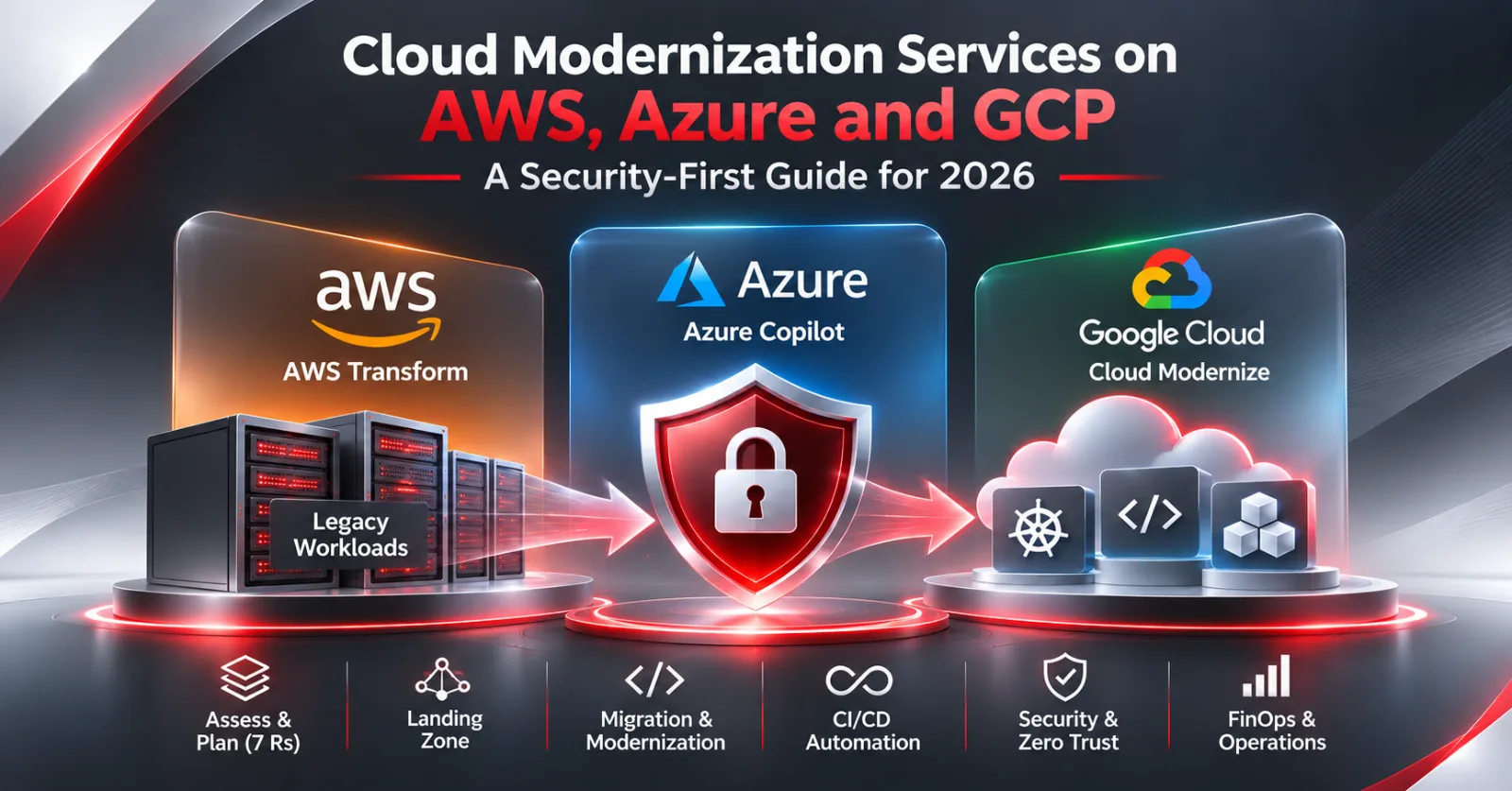
Key takeaway: Cloud modernization services on Amazon Web Services (AWS), Azure and Google Cloud Platform (GCP) now pair human architects with artificial intelligence (AI) agents that assess, convert and upgrade code. AWS leads with AWS Transform, Azure with Copilot agents, Google with Google Cloud Modernize. Pick the platform by workload and identity estate, then build the landing zone, policy guardrails and continuous integration and continuous delivery (CI/CD) security gates first.
Cloud modernization services on AWS and Azure, and now Google Cloud, changed more in 2026 than in the previous five years. All three providers now ship agents that read your codebase, propose a plan and open pull requests. That speeds delivery. It also creates a new class of privileged automation that most security teams have not reviewed.
We run modernization and security engagements across AWS, Azure and Google Cloud. This guide compares what each platform offers today, where each fits, and the security gates we insist on before any agent touches production code.
What are cloud modernization services?
Cloud modernization is the process of re-architecting applications, data and infrastructure so they use cloud-native services, automation and security controls instead of simply running old servers in a new data center. Cloud modernization services are the consulting, engineering and managed work that carries an organization through that process.
Modernization is not the same as migration. A lift-and-shift moves a virtual machine (VM); modernization changes how the workload is built, deployed, secured and paid for.
What do cloud modernization services on AWS and Azure include?
On AWS, Azure and Google Cloud alike, a complete engagement covers assessment, landing zone, migration, code and data modernization, automation, and ongoing operations. The vocabulary differs, but the work is the same.
AWS frames the options as the “7 Rs” of migration strategy: retire, retain, rehost, relocate, replatform, repurchase and refactor (AWS Prescriptive Guidance). Microsoft structures the journey through the Cloud Adoption Framework, whose Ready phase delivers an Azure landing zone before workloads arrive.
Google Cloud publishes equivalent landing zone design guidance, built on organization policy constraints, virtual private cloud (VPC) Service Controls perimeters, Cloud Key Management Service (KMS) and Security Command Center. Our Google Cloud security guide walks through all seven layers.
A typical scope of enterprise cloud services includes:
- Portfolio assessment: dependency mapping, total cost of ownership (TCO), and a 7 Rs decision per application.
- Landing zone: account or subscription structure, identity, networking, logging and policy guardrails.
- Migration and modernization: rehosting where it makes sense, replatforming to containers or PaaS, refactoring to serverless.
- CI/CD automation: pipelines, infrastructure as code with Terraform, Bicep or CloudFormation, and security scanning.
- Operations: FinOps, observability, backup and disaster recovery, and security operations center (SOC) monitoring.
What changed in 2026?
In 2026, AWS, Microsoft and Google all turned modernization into an agent-driven workflow. AWS expanded AWS Transform month after month, Microsoft put migration and modernization agents into Azure Copilot and GitHub Copilot, and Google bundled its tools into Google Cloud Modernize. The human role shifted from writing conversion code to reviewing plans and pull requests.
AWS: AWS Transform
- 20 May 2026: AWS Transform began modernizing networks during VMware migrations, including splitting mixed-tier virtual private clouds (VPCs), right-sizing Classless Inter-Domain Routing ranges (CIDRs) and flagging unrestricted security group rules (AWS).
- 3 Aug 2026: continuous modernization reached general availability. It scans GitHub, GitLab and Bitbucket repositories, ranks technical debt and security findings, and opens pull or merge requests, running in the customer’s own AWS account with the customer’s credentials (AWS).
- 16 Oct 2026: Azure-to-AWS code conversion became generally available in the .NET modernization agent, covering Azure Functions to Lambda, Blob Storage to Amazon Simple Storage Service (S3) and Queue Storage to Amazon Simple Queue Service (SQS), with Cosmos DB to DynamoDB in preview (AWS).
- 3 Nov 2026: the mainframe reimagine workflow added field-level business-function discovery and a requirements coverage report for z/OS Common Business-Oriented Language (COBOL) and Programming Language One (PL/I).
Azure: Azure Copilot and GitHub Copilot agents
On 11 March 2026, Microsoft announced the Azure Copilot migration agent and the GitHub Copilot modernization agent, both in public preview (Azure Blog). The migration agent covers discovery, assessment, planning and deployment for servers, virtual machines (VMs), applications and databases. The GitHub agent runs code assessments in parallel and executes framework and runtime upgrades, and its reports feed the migration agent.
Microsoft’s post cites a Forrester Q1 2026 survey in which 91% of 223 information technology (IT) leaders said application modernization is necessary for AI. That matches what we hear from chief technology officers (CTOs): modernization budgets are now justified as AI readiness, the same case we make in our guide to AI strategy and AI return on investment (ROI).
Google Cloud: Google Cloud Modernize
On 5 October 2026, Google launched Google Cloud Modernize, a portfolio that brings together Migration Center, Google Cloud VMware Engine, Mainframe Modernization, Modernization Hub and a new EKS-to-GKE migration agent (Google Cloud Blog).
- 25 Aug 2026: Migration Center added Gemini-powered quick assessments for TCO modeling and service mapping from VMware exports. Analysts quoted in the coverage called AI TCO outputs “directional screening estimates” (Network World).
- 5 Oct 2026: the Agentic Quick Estimator in Migration Center became generally available, and Modernization Hub’s App Modernization command-line interface (CLI) (CodMod) uses Gemini to analyze Java, .NET and mainframe repositories and recommend changes.
- EKS-to-GKE migration agent (public preview): maps identity and access management (IAM) Roles for Service Accounts to Workload Identity, Application Load Balancer (ALB) ingress to Gateway API and Karpenter to Google Kubernetes Engine (GKE) node provisioning. It generates Terraform and opens pull requests rather than changing live clusters, and it does not move stateful data (Google Cloud Blog).
The EKS-to-GKE agent is a direct play for AWS Kubernetes workloads, just as AWS Transform now converts Azure code to AWS. Every hyperscaler is using agents to make leaving a competitor cheaper, so expect migration offers from all three in your next renewal.
AWS vs Azure vs GCP: which is better for modernization?
No single platform is better in general; the right choice depends on your identity estate, your application stack and where your data already lives. Microsoft-centric estates with Entra ID, .NET and Microsoft 365 usually modernize faster on Azure. Open-source, container-heavy or mainframe workloads often favor AWS. Kubernetes-first and data-and-analytics-heavy teams, especially those standardizing on GKE and BigQuery, often favor Google Cloud.
| Capability | AWS | Azure | Google Cloud (GCP) |
|---|---|---|---|
| Landing zone | AWS Control Tower, Landing Zone Accelerator | Azure landing zone accelerator (Cloud Adoption Framework) | Landing zone design guidance and security foundations blueprint |
| Migration and assessment | AWS Transform (VMware, network, Windows) | Azure Copilot migration agent (public preview) | Migration Center with Gemini quick assessments; Agentic Quick Estimator (GA) |
| Code modernization | AWS Transform for .NET, mainframe, continuous modernization | GitHub Copilot modernization agent (public preview) | Modernization Hub and App Modernization CLI (CodMod); EKS-to-GKE agent (preview) |
| Identity | IAM, IAM Identity Center | Microsoft Entra ID, managed identities | Cloud IAM, Workload Identity Federation |
| Policy guardrails | Service control policies, AWS Config | Azure Policy, management groups | Organization policy constraints, VPC Service Controls |
| Security posture | Security Hub, GuardDuty | Microsoft Defender for Cloud, Microsoft Sentinel | Security Command Center, Google Security Operations |
| Infrastructure as code | CloudFormation, Cloud Development Kit (CDK), Terraform | Bicep, Azure Resource Manager (ARM), Terraform | Terraform, Infrastructure Manager |
| CI/CD automation | CodePipeline, GitHub Actions | Azure DevOps, GitHub Actions | Cloud Build, Cloud Deploy, GitHub Actions |
“Teams ask us which cloud has the better modernization agent. The better question is which cloud has your identities. Modernization fails on permissions and networking far more often than on code conversion, so start where your Zero Trust controls already work.”
iNET SYSTEMS Cloud Practice
Running more than one cloud is normal. A common pattern keeps Microsoft 365 and Entra ID as the identity plane, runs selected workloads on AWS, and puts analytics or GKE workloads on Google Cloud. In that case, federate identity once, standardize on Terraform across all three clouds, and send logs from every cloud to one security information and event management (SIEM). Our Azure consulting, AWS consulting and Google Cloud consulting teams work from the same modules.
How do you secure a cloud modernization program?
Secure a modernization program by building the landing zone and identity controls before migrating anything, then enforcing policy-as-code and security gates in every pipeline. Treat modernization agents like privileged engineers: scoped identities, reviewed pull requests and full audit logs.
- Build the landing zone first. Separate accounts, subscriptions or projects per environment, central logging, and hub-and-spoke, Transit Gateway or Shared VPC networking. See our Azure landing zone guide for the Azure side.
- Federate identity and remove standing access. Single sign-on through Entra ID, IAM Identity Center or Cloud Identity, just-in-time elevation, and no long-lived access or service account keys. On GCP, use Workload Identity Federation instead of key files.
- Enforce guardrails as code. Service control policies, Azure Policy or GCP organization policy constraints to block public storage, require encryption and restrict regions. Add VPC Service Controls perimeters around sensitive GCP data.
- Automate CI/CD with security gates. Every change goes through a pipeline with infrastructure as code (IaC) scanning, static application security testing (SAST), dependency checks and container image signing. No console changes in production. See CI/CD automation and our CI/CD security guide for AWS, Azure and GCP.
- Govern the modernization agents. Give AWS Transform, GitHub Copilot, Google’s EKS-to-GKE agent or any other agent its own identity with read access to source and write access only to branches. Humans approve merges. Our agentic AI governance framework covers this in depth.
- Protect data in motion. Private endpoints, PrivateLink or Private Service Connect, customer-managed keys (AWS KMS, Azure Key Vault, Cloud KMS) for regulated data, and tested database cutover with rollback.
- Instrument before cutover. Defender for Cloud, Security Hub or Security Command Center enabled, logs flowing to Microsoft Sentinel or your SIEM, and alerts tuned for the new architecture.
- Prove resilience. Run a disaster recovery test and a rollback rehearsal before decommissioning the source system.
Security risks unique to AI-driven modernization
- Over-privileged agents: an agent that can push to main or deploy is a supply-chain risk.
- Silent behavior changes: converted code that compiles but changes business logic. Require test coverage before conversion.
- Secrets in repositories: agents that scan repositories will also read hard-coded credentials. Rotate and vault them first.
- Configuration drift: network constructs generated during migration that bypass your standard modules. Re-import them into Terraform.
How do you choose a cloud modernization partner?
Choose a partner that can show multi-cloud delivery, security engineering and governance in the same team, not separate vendors for each. Ask for a sample landing zone design, a pipeline with security gates, and a written approach to governing AI modernization agents.
- Certified engineers on AWS, Azure and Google Cloud, with references for your workload type.
- Infrastructure as code by default, with modules you own after the engagement.
- A security-first method aligned to Zero Trust, Center for Internet Security (CIS) Benchmarks and your compliance framework (System and Organization Controls 2 (SOC 2), International Organization for Standardization (ISO) 27001 or Health Insurance Portability and Accountability Act (HIPAA)).
- Clear FinOps reporting so modernization savings are measured, not assumed.
- An exit plan: documentation, runbooks and knowledge transfer to your team.
Planning a modernization on AWS, Azure or Google Cloud?
Book a cloud security assessment with iNET SYSTEMS. We review your landing zone, identity, pipelines and modernization agents, and hand you a prioritized, platform-specific roadmap.
