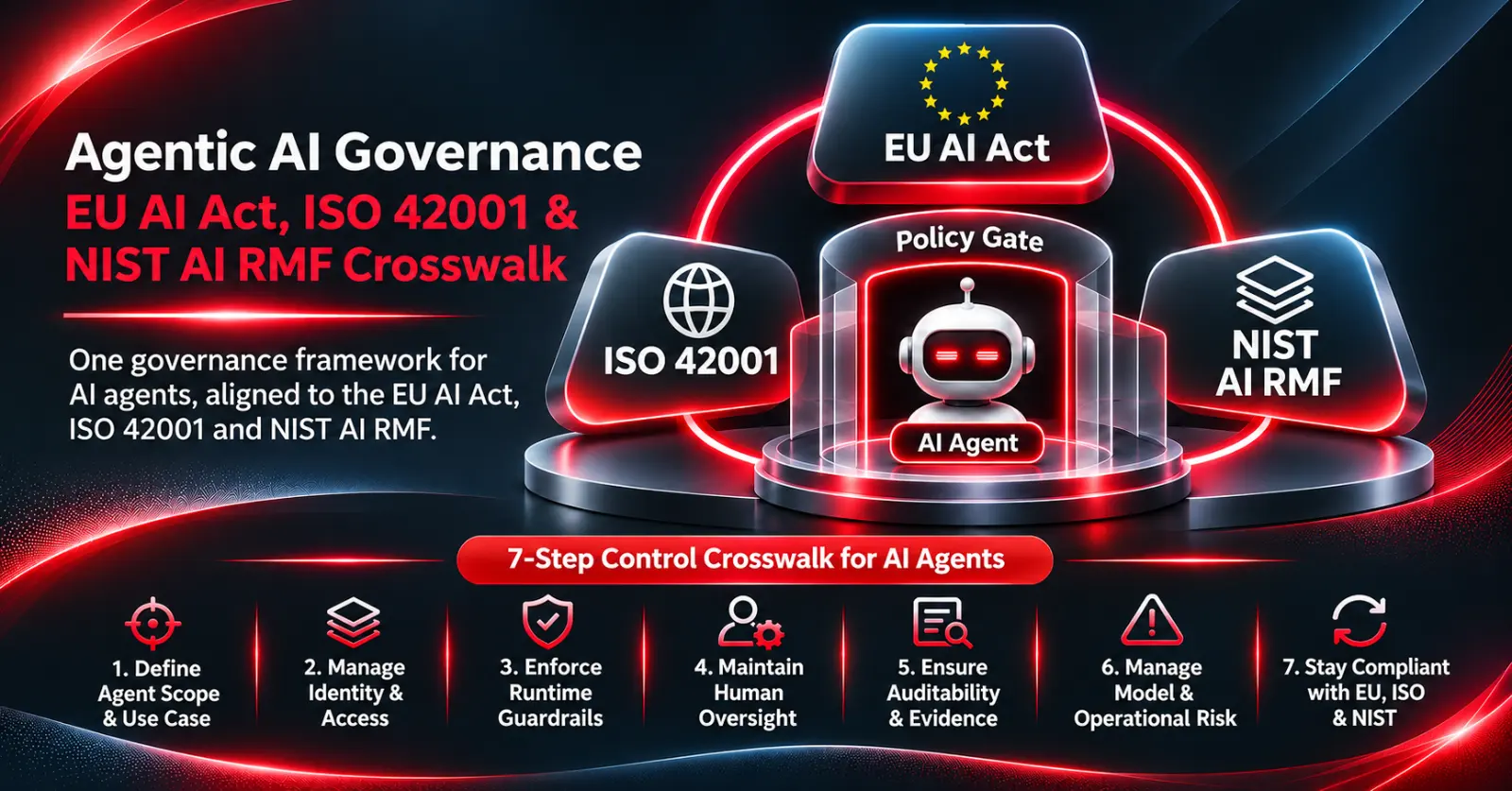
Key takeaway: The European Union (EU) artificial intelligence (AI) Act applies to AI agents through their use case, not by name. Agentic AI governance is the set of policies, identity controls, runtime guardrails and audit evidence that keep those agents acting within approved limits. After the EU Digital Omnibus, stand-alone high-risk AI obligations apply from 2 December 2027. The fastest path is one control set mapped to the EU AI Act, International Organization for Standardization and International Electrotechnical Commission (ISO/IEC) 42001 and National Institute of Standards and Technology (NIST) AI Risk Management Framework (AI RMF) at once.
What does governing an AI agent involve?
Agentic AI governance is the discipline of defining what an AI agent may do, proving it only did that, and stopping it when it tries something else. It covers the agent’s job definition, its identity and permissions, runtime checks on each action, human oversight and the audit trail.
In our engagements, the difference from classic model governance is simple. A model produces an answer that a person reads. An agent books, buys, deploys, emails or deletes. Governance therefore has to move from reviewing outputs to authorizing actions. Our agentic AI governance framework for chief information security officers (CISOs) covers the full program; this post maps it to the three frameworks auditors use.
That shift is now measurable. On 11 November 2026, Cequence Security published a report with input from KPMG in Singapore. In a controlled study, agents holding only logins and fixed permissions tried to act outside their job in 44% of runs. With a defined job and per-action checks, that fell to 1%, and task completion rose from 76% to 95% (GlobeNewswire).
What changed in the EU AI Act timeline?
The Digital Omnibus on AI pushed the core high-risk obligations back by more than a year. Stand-alone (Annex III) high-risk systems now have until 2 December 2027, and product-embedded (Annex I) systems until 2 August 2028.
The Omnibus is Regulation (EU) 2026/1744 of 8 July 2026 and entered into force on 27 July 2026 (White & Case). Before it, most obligations, including core high-risk duties, were due on 2 August 2026.
The dates that matter for agent programs:
| Obligation | Date now in force | What it means for AI agents |
|---|---|---|
| Art. 50(2) marking of AI-generated content (systems on the market before 2 Aug 2026) | 2 December 2026 | Agents that generate customer-facing content need machine-readable marking |
| New Art. 5 prohibitions on non-consensual intimate content and child sexual abuse material (CSAM) | 2 December 2026 | Content-generating agents need hard output filters |
| Annex III high-risk (Art. 6(2)) | 2 December 2027 | Agents used in human resources (HR), credit and essential services need full risk management, logging and oversight |
| Annex I high-risk (Art. 6(1)) | 2 August 2028 | Agents embedded in regulated products |
The two new Article 5 prohibitions cover AI systems that generate non-consensual intimate images or child sexual abuse material, and they apply to providers that lack reasonable safeguards (Orrick).
The Omnibus also rewrote the AI literacy duty in Article 4. Providers and deployers must now “take measures to support the development of AI literacy” without guaranteeing a specific level for each person.
Our read: the delay is not a pause. The record-keeping (Art. 12), human oversight (Art. 14) and deployer duties (Art. 26) are unchanged in substance. Teams that build them now get 13 months of operating evidence before the deadline.
Why do AI agents need different governance than chatbots?
Agents need different governance because they hold credentials and take consequential actions across systems. A chatbot’s worst case is a bad answer; an agent’s worst case is a bad transaction executed at machine speed.
The risks are now catalogued. The OWASP Top 10 for Agentic Applications for 2026, released on 9 December 2025, covers threats such as goal hijacking, tool misuse and identity and privilege abuse.
The traffic is already real. In one week of October 2026, Cequence tracked more than 250,000 AI agent visits across five industries; about one in seven booked, bought, signed in or managed an account (GlobeNewswire).
What changes in practice:
- Identity: every agent needs its own workload identity, not a shared service account or a human’s token.
- Authorization: permissions are scoped per task and per action, not per application.
- Oversight: humans approve classes of consequential actions, not every prompt.
- Evidence: logs capture the tool call, parameters, policy decision and outcome, not just the chat transcript.
- Kill switch: an operator can revoke an agent’s credentials in minutes.
How do the EU AI Act, ISO 42001 and NIST AI RMF map to each other?
They map cleanly because they ask for the same core things: risk management, records, oversight, competence and supplier control. The EU AI Act sets legal duties, ISO/IEC 42001 provides a certifiable management system, and NIST AI RMF gives the Govern, Map, Measure and Manage vocabulary.
ISO/IEC 42001:2023 is the first international standard for an AI management system (AIMS). The NIST AI RMF 1.0 was released in January 2023 and is voluntary. Neither names AI agents explicitly, so the agent-specific control column is where practitioners add value. For the control-catalog view, see our NIST Special Publication (SP) 800-53 control map for AI agents.
| Governance area | EU AI Act | ISO/IEC 42001 | NIST AI RMF | Agent-specific control |
|---|---|---|---|---|
| Risk management | Art. 9 | Cl. 6.1, 8.2 (AI risk assessment) | MAP, MEASURE | Risk-tier each tool an agent can call |
| Impact assessment | Art. 27 (fundamental rights impact assessment (FRIA), certain deployers) | Cl. 6.1.4, 8.4; Annex A.5 | MAP | Assess downstream effect of autonomous actions |
| Record-keeping / logs | Art. 12 | Annex A.6 (lifecycle, event logs) | MEASURE | Per-action trace: tool, parameters, policy verdict |
| Human oversight | Art. 14 | Annex A.9 (use of AI systems) | MANAGE | Approval gates for payments, deletes, external sends |
| Deployer duties | Art. 26 | Cl. 8 (operation) | GOVERN | Named business owner per agent |
| Transparency | Art. 50 | Annex A.8 (info for interested parties) | GOVERN | Disclose agent identity to users and application programming interfaces (APIs) |
| AI literacy / competence | Art. 4 | Cl. 7.2, 7.3 | GOVERN | Train operators on agent failure modes |
| Third parties | Art. 25 | Annex A.10 | GOVERN, MAP | Vet Model Context Protocol (MCP) servers, plugins and model providers |
“Don’t build an EU AI Act program, an ISO 42001 program and a NIST program. Build one agent control plane, then tag every control with the clause it satisfies. Auditors care about evidence, and evidence only needs to be produced once.”
iNET SYSTEMS AI Practice
How do I prepare AI agents for the EU AI Act and ISO 42001 in 7 steps?
Start with an inventory, give every agent an identity and a written job, enforce that job at runtime, and log every decision. The seven steps below are the sequence we use with clients on Azure, Amazon Web Services (AWS) and Google Cloud.
- Inventory every agent. Record owner, model, tools, data sources, credentials and the business process it touches. Include agents built in low-code platforms.
- Classify risk. Tag each agent against EU AI Act Annex III use cases and your own impact tiers. Anything touching HR, credit or customer accounts goes to the top tier.
- Write the job description. Define in plain language what the agent may and may not do, then translate it into machine-checkable policy (allowed tools, parameter limits, spend caps).
- Issue a dedicated identity. Use a workload identity (Microsoft Entra Agent ID, AWS identity and access management (IAM) roles, Google Cloud Platform (GCP) service accounts) with least privilege and short-lived tokens. Apply Zero Trust: no standing access. See Entra ID and identity security.
- Enforce per-action guardrails. Put a policy decision point between the agent and its tools that can approve, escalate to a human or block each call. Our guide to runtime controls for AI agents covers this layer in depth.
- Log and monitor. Stream agent traces to your security information and event management (SIEM) (for example Microsoft Sentinel). Alert on denied actions, privilege escalation attempts and unusual tool sequences.
- Test and review. Red-team agents against the Open Worldwide Application Security Project (OWASP) agentic risks before release and quarterly after, starting with an AI agent security assessment. Feed findings into the ISO 42001 management review.
What evidence will auditors ask for?
Auditors will ask you to prove three things: you knew which agents existed, you controlled what they could do, and you can reconstruct what they did. Policy documents alone will not pass.
The evidence pack we prepare for an ISO 42001 stage 2 audit or an EU AI Act readiness review contains:
- Agent inventory with owners and risk tiers
- Job descriptions and the policy code that enforces them
- IAM role definitions and access review records
- Sample per-action logs with policy verdicts
- Human-oversight approvals for high-impact actions
- Red-team reports and remediation tickets
- AI literacy training records for operators
If you cannot produce these for one agent today, start there. Governance scales from one well-evidenced agent, not from a 40-page policy. For a worked example in healthcare, see our private Microsoft Foundry agent for protected health information (PHI).
Book an EU AI Act readiness assessment for your AI agents
Running AI agents in production, or about to? iNET SYSTEMS will inventory your agents, map them to the EU AI Act, ISO 42001 and NIST AI RMF, and hand you a prioritized control plan. Book an AI governance assessment or talk to our AI governance consulting team.
