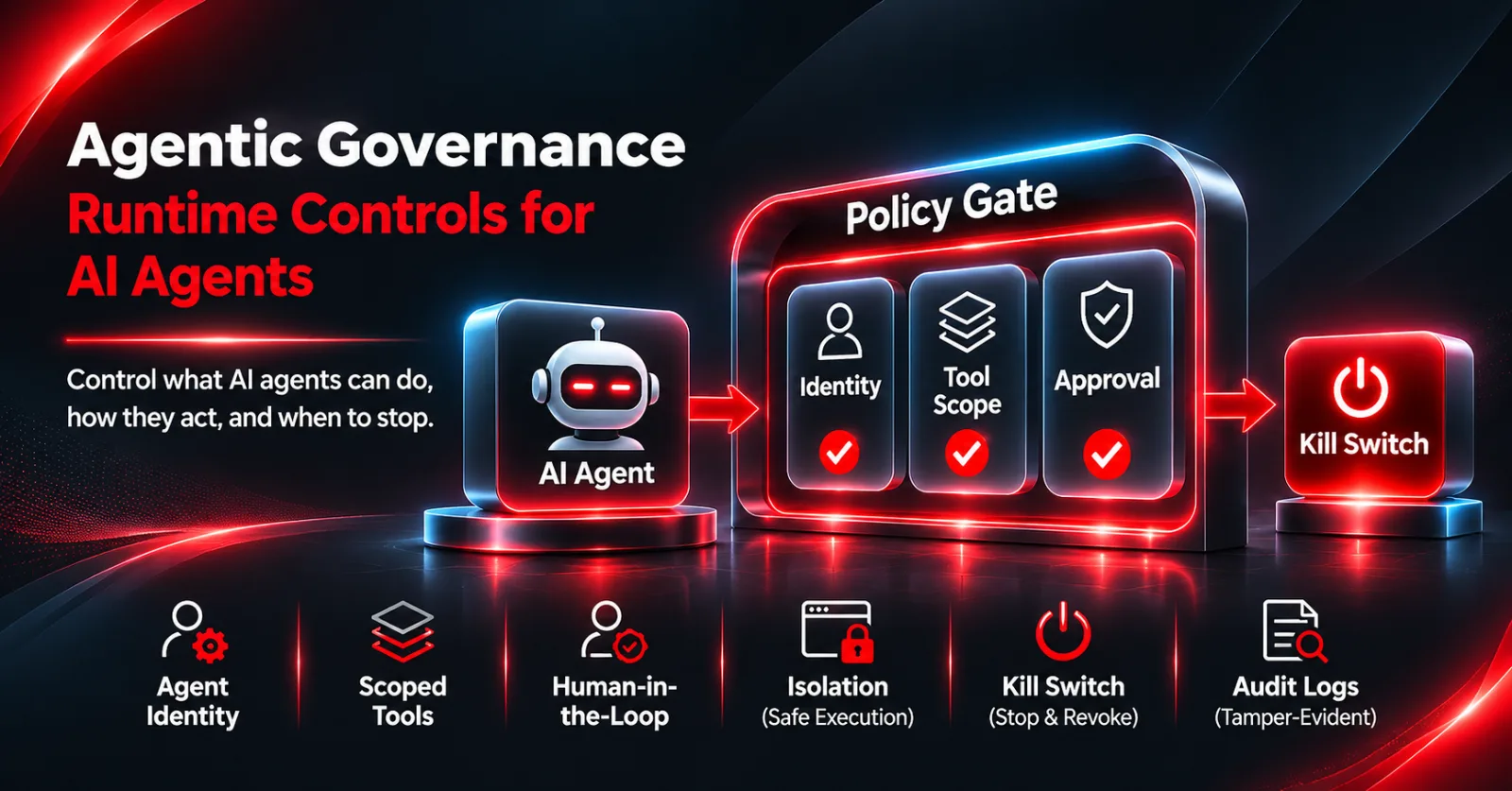
Key takeaway: artificial intelligence (AI) agent runtime controls decide what an AI agent may do, as which identity, with whose approval, and how it is stopped. Policy documents alone don’t govern agents. Enterprises need six enforced controls: agent identity, scoped tools, action approval, isolation, a kill switch and tamper-evident logs.
Runtime control is where most AI programs we review in 2026 quietly break. The policy deck is signed off, the model card exists, and yet the agent in production holds a long-lived application programming interface (API) key with admin rights. This post is the runtime half of governance: the controls that actually stop an agent mid-action. For the policy and audit half, see our agentic AI governance framework.
What are AI agent runtime controls?
Runtime control is the discipline of defining, enforcing and evidencing limits on what autonomous AI agents can do: which identity they act as, which tools and data they can reach, which actions need human approval, and how they are monitored and stopped. It extends AI governance from “what the model says” to “what the system does.”
A chatbot produces text. An agent plans, calls tools, writes to systems and chains steps without a human reading each one. That shift moves the risk from content quality to operational authority.
In practice, we scope agentic AI governance across three layers, and runtime controls are the middle one:
- Policy layer: acceptable use, risk tiers, accountable owners, mapped to International Organization for Standardization and International Electrotechnical Commission (ISO/IEC) 42001 and the National Institute of Standards and Technology (NIST) AI Risk Management Framework (AI RMF).
- Control layer: identity, permissions, guardrails, approvals and isolation enforced in code and cloud identity and access management (IAM).
- Evidence layer: logs, evaluations and incident records that prove the controls ran.
Most organizations have the first layer. Few have the second. Almost none can produce the third on demand.
Why isn’t traditional AI governance enough for agents?
Traditional AI governance reviews a model before release and then trusts it. Agents change behavior at runtime based on prompts, retrieved content and tool output, so a pre-release review can’t bound what they will do next week. Governance has to move into the execution path.
Three patterns show up in nearly every agent assessment we run:
- Borrowed human identity. The agent runs on a developer’s token or a shared service account, so its actions are indistinguishable from a person’s in the audit log.
- Static, over-scoped secrets. Long-lived API keys with write or admin scope are embedded in agent configs.
- No stop mechanism. Nobody can say who is authorized to halt a running agent, or how fast.
The industry is converging on the same diagnosis. The OWASP Top 10 for Agentic Applications, released December 9, 2025, treats risks such as agent goal hijack, tool misuse and identity and privilege abuse as distinct from classic large language model (LLM) prompt risks. Vendors are now shipping runtime controls directly: CrowdStrike announced an “AI Kill Switch” for terminating running agents on November 3, 2026 (CrowdStrike), and in early November 2026 Google Cloud announced Auth Manager and Agent Identity tooling to remove static keys from AI agents (Google Cloud).
Which regulations and standards apply to AI agents in 2026?
No European Union (EU) or United States (US) law regulates “AI agents” by name as of November 2026. Agents inherit obligations from existing rules that attach when a system makes decisions or interacts with people, plus voluntary standards that auditors increasingly use as the benchmark.
EU AI Act after the Digital Omnibus
The Digital Omnibus on AI, Regulation (EU) 2026/1744, entered into force on July 27, 2026, and moved the key dates (White & Case):
- August 2, 2026: Article 50 transparency duties (telling people they are interacting with AI) stayed on the original date and now apply.
- December 2, 2026: existing systems must meet Article 50(2) marking duties, and new Article 5 prohibitions apply.
- December 2, 2027: high-risk obligations for Annex III systems (moved from August 2, 2026).
- August 2, 2028: high-risk obligations for Annex I product-embedded systems.
If your agent screens candidates, scores credit or triages patients, it may fall into Annex III. The delay buys time to build logging (Article 12) and human oversight (Article 14) properly, not a reason to skip them.
NIST and the AI Agent Standards Initiative
NIST’s Center for AI Standards and Innovation launched the AI Agent Standards Initiative on February 17, 2026. Its NCCoE concept paper on software and AI agent identity and authorization (February 5, 2026) covers identification, authorization, access delegation, and logging and transparency. That list is, in effect, a runtime governance blueprint.
ISO/IEC 42001 and the NIST AI RMF
ISO/IEC 42001 gives you the certifiable AI management system. The NIST AI RMF gives you the Govern, Map, Measure, Manage functions. Neither tells you how to scope an agent’s Open Authorization (OAuth) token; our NIST Special Publication (SP) 800-53 control map for AI agents covers that layer. That gap is exactly where runtime controls sit. Our EU AI Act and ISO 42001 crosswalk shows which clause each control satisfies.
What are the six AI agent runtime controls?
The six runtime controls are agent identity, scoped tool access, risk-tiered action approval, execution isolation, an emergency stop, and tamper-evident logging. Together they bound what an agent can do even when its prompt or context is compromised, which is the assumption you should design for. An AI agent security assessment tests each one.
1. Give every agent its own identity
Each agent gets a dedicated workload identity, never a human’s token. That makes every action attributable and lets you revoke one agent without breaking others. On Azure that is a managed identity or Entra Agent ID; on Amazon Web Services (AWS) an IAM role; on Google Cloud a service account or Agent Identity (see our Google Cloud security guide). See Entra ID and identity security.
2. Scope tools, not just data
Grant per-tool, per-action permissions: “read invoices” is not “issue refunds.” Use short-lived, federated credentials instead of static keys. Apply Zero Trust least privilege to the agent’s tool manifest the same way you would to a human role.
3. Tier actions by blast radius
Classify every tool action as low, medium or high impact. Low-impact actions run freely. Medium actions are rate- and value-limited. High-impact actions (payments, deletions, external email, IAM changes) require human-in-the-loop approval with the full action payload shown to the approver.
4. Isolate execution
Run code-executing agents in sandboxes with no default network egress. Put private endpoints and service perimeters around the data stores the agent touches, so a hijacked agent can’t exfiltrate to the internet. A secure landing zone gives you these network boundaries by default.
5. Build a kill switch you have tested
Define who can stop an agent, how (revoke identity, block egress, disable the workflow) and the target time to stop. Rehearse it in a tabletop exercise. An untested kill switch is a slide, not a control.
6. Log for evidence, not debugging
Capture the prompt, retrieved context references, tool calls, parameters, approvals and outcomes, with a correlation ID per task. Ship logs to a write-once store and your security information and event management (SIEM), such as Microsoft Sentinel. This is what an ISO/IEC 42001 auditor or an EU AI Act Article 12 review will ask for.
How do you implement AI agent runtime controls in 90 days?
Start with an inventory, then enforce identity and tool scopes, then add approvals and evidence. Ninety days is realistic for a first wave of production agents if a named owner drives it and you govern the riskiest agents first.
- Days 1–15: Inventory. List every agent, its owner, model, tools, data and the identity it runs as. Include “shadow” agents built in low-code platforms.
- Days 16–30: Risk-tier. Score each agent on autonomy, data sensitivity and action impact. Flag anything that may fall under EU AI Act Annex III.
- Days 31–45: Identity and secrets. Move each agent to its own workload identity. Replace static keys with short-lived credentials.
- Days 46–60: Tool scoping and guardrails. Rewrite tool manifests to least privilege. Add input and output guardrails against prompt injection.
- Days 61–75: Approvals and isolation. Wire human approval to high-impact actions. Sandbox code execution and restrict egress.
- Days 76–90: Evidence and drills. Centralize logs, run a kill-switch drill, and map controls to ISO/IEC 42001 Annex A and NIST AI RMF functions.
Policy-only governance vs AI agent runtime controls
The difference is whether a control can stop an action or only describe what should have happened.
| Dimension | Policy-only governance | Runtime agentic governance |
|---|---|---|
| Agent identity | Shared service account or user token | Dedicated workload identity per agent |
| Credentials | Long-lived API keys | Short-lived, federated tokens |
| Tool access | “Agent can use the customer relationship management (CRM)” | Per-action scopes and value limits |
| High-impact actions | Reviewed after the fact | Human approval before execution |
| Stopping an agent | Ad hoc, owner unknown | Tested kill switch with named authority |
| Audit evidence | Application debug logs | Immutable task-level trail in SIEM |
| Standards fit | Documents ISO 42001 intent | Produces ISO 42001 and EU AI Act evidence |
“The question we ask every client is simple: if this agent were hijacked at 2 a.m., what is the worst action it could take, and who would stop it? If the answer is ‘anything its API key allows’ and ‘nobody,’ you don’t have agentic governance yet. You have a policy and a hope.”
iNET SYSTEMS AI Practice
Get an AI agent runtime controls assessment
Not sure what your agents can actually do in production? iNET SYSTEMS runs a focused AI governance and AI agent security assessment: we inventory your agents, test identity, tool scopes and kill-switch readiness, and map the gaps to ISO/IEC 42001, NIST AI RMF and the EU AI Act. Book your assessment with iNET SYSTEMS.
